
Why Juncos Matter
As an amateur birdwatcher, I confess that I fall victim to that all too familiar amateur-birdwatcher notion that rare birds are cooler than common birds. It’s all about the life list, baby! You’ve seen one house sparrow, you’ve seen them all. A pine grosbeak, though? Swoon
A few years ago, Mala and I were birdwatching around Lake Artemesia in Maryland. Seeing our binoculars trained into a tree, a passerby asked what we were seeing. I responded, quite innocently, “oh, it’s just a chickadee.”
Well. Did I ever learn MY lesson. “Just a chickadee? There’s no such thing as “just” a chickadee. Every chickadee is special.” The tone in her voice, though. Phew.
Except I didn’t learn my lesson. Later, again at Lake Artemesia, a non-birdwatching friend saw a red-winged blackbird – or rather, noticed one for the first time in her life – and gasped, “wow, what a beautiful bird!” And I, in my most sophisticated voice, scoffed, “oh, that’s just a red-winged blackbird.” My friend was like, really, Vega? “Just” a blackbird? A second later, the blackbird flexed his red wings, and I gasped. My friend was like, “yeah, there it is. It is beautiful, isn’t it?”
Did I learn my lesson then? Yes…and no.
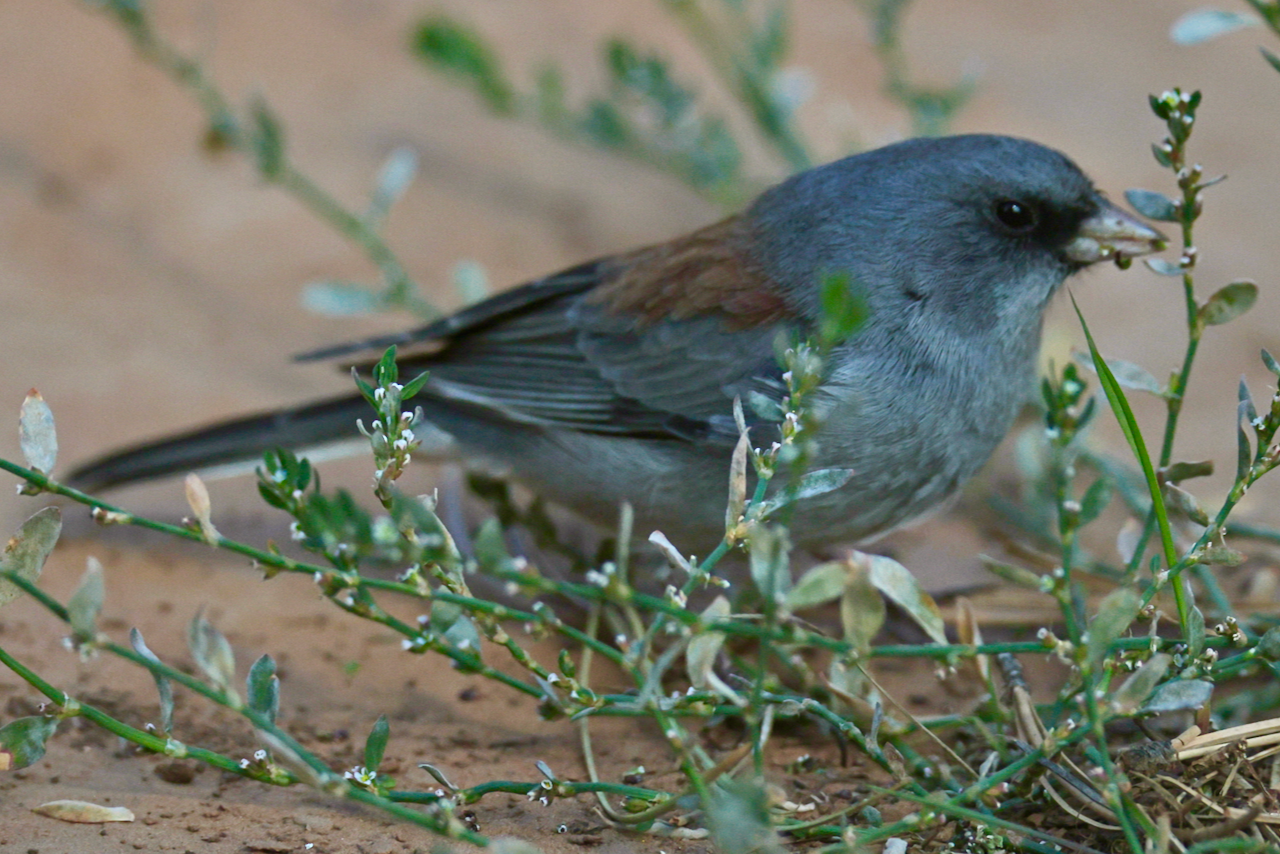
Let’s talk about the junco. The junco is an unassuming little sparrow, pretty common, lots of different subspecies, roving around much of North America at any given moment, especially in winter. The junco is not a bird that life listers will brave the howling winds of the Alaskan tundra to see. The junco is….a bird. And yet, it is remarkable in its own right.
Juncos live just off parking lots, among other very exposed spaces. Spaces where their predators theoretically could just find them and pluck them off one by one, no problem. They hang out on the ground, hopping around, picking at insects and seeds. Their nests are in the ground, right there in the open fields.
There are a couple dozen subspecies of juncos. They all gather together, especially in the winter when food is scarcer and predators more worrisome. They interbreed. They take care of each other’s young. They flock together: strength in numbers.
They have lasted this long, as one of the most abundant bird species the world has ever known, even in the most exposed, easily-targeted areas of the world, because they interbreed, take care of each other, squawk loudly to warn their fellow birds when they sense danger, and gather across subspecies to protect each other when conditions are toughest. And that's how they keep surviving, against all odds.
It’s easy for me to valorize birds who are rare and flashy. Look! There is a rare and flashy bird! A bird worthy of stopping for! Ooh! Aah! I seek to add their names to my life list. I peer through the shrubs and point my binoculars far into the woods, seeking a glimpse of an elusive feather, imagining that when I get that glimpse, then everything will be better. Meanwhile, I walk past multitudes of birds who are doing the heroic work every day to keep themselves alive, and, over time, thriving.
I walk in the myth that the rare and flashy birds matter most. In the meantime, it’s the black-eyed juncos, with their squawking, their gathering across subspecies, their mutual aid when conditions are toughest, that truly matter most.
This is a post about Minnesotans.